Chase Sapphire Reserve Personal vs. Business: Differences, Overlaps, and Who Each is For
Disclosure: This post may contain affiliate links, which earn me a small commission from bookings at no extra cost to you. Thank you for reading and supporting my blog! Content is for informational purposes only and isn't financial advice. Card offers and terms change often, so check the issuer's site for current details before you apply. Opinions are my own and haven't been reviewed or endorsed by any card issuer.
“Plunk!” That heavy navy blue metal card hits the check and the everyone around the table wonders, “What’s that card?” It’s the Chase Sapphire Reserve. Whether it’s the personal or business card is going to take some closer inspection.
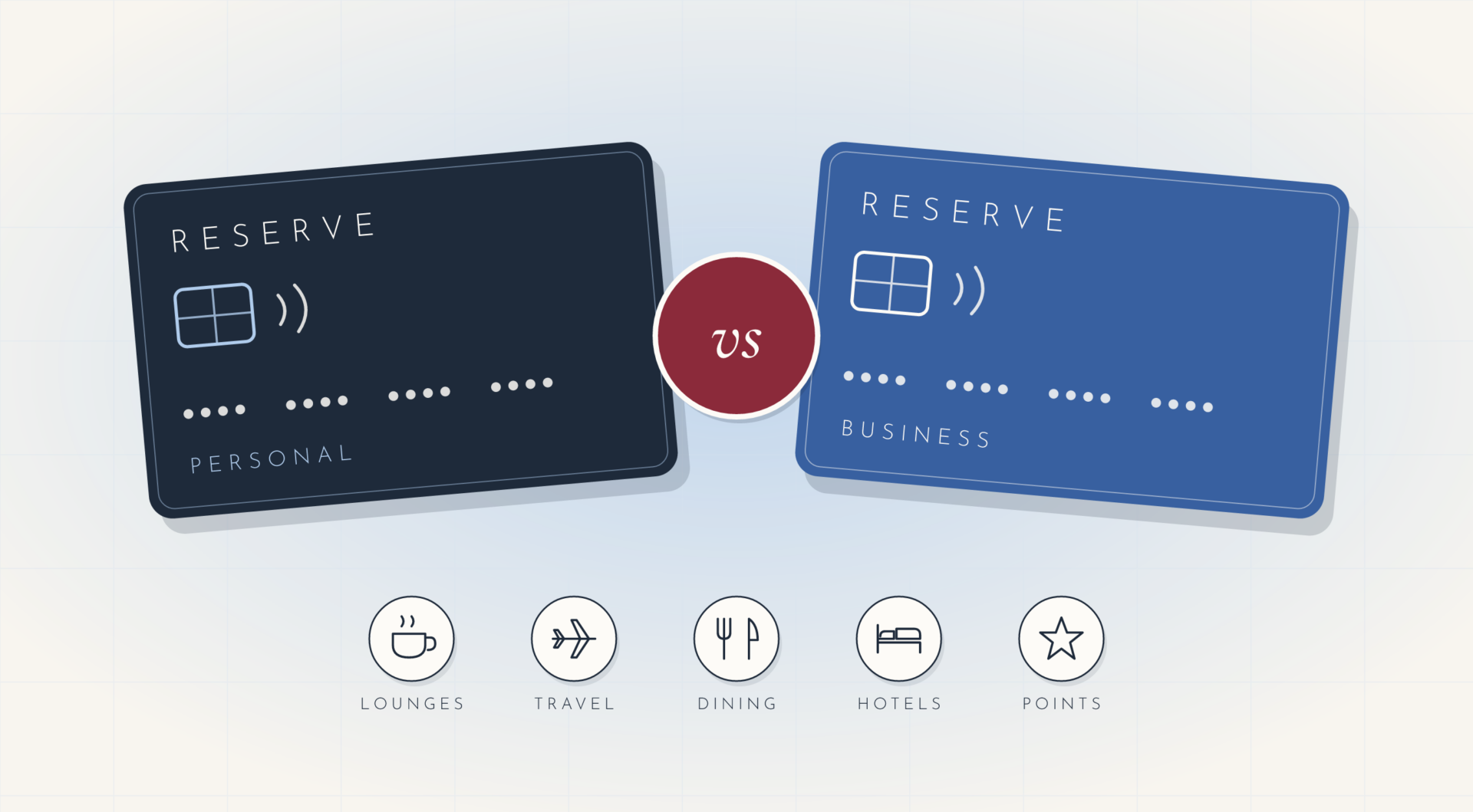
With similar benefits and the same $795 annual fee, the Chase Sapphire Reserve Personal and Business cards may seem the same, but they are geared towards completely people. A few distinctions on the credits and earnings make a huge difference on getting value out of the annual fee.
In my family, we kept the business version for a year. On paper, the credits more than covered the fee. In practice, The Edit hotel credit was hard to use, and we left one of the two $250 credits on the table. When we called to cancel, Chase had no downgrade option and no retention offer for us, even after a year of heavy spending.
I won’t deny we did get used to some of the perks though, so then we had to consider the personal card. Here’s how the two cards compare, where they overlap, who each one is really for, and what I think would make this card worth keeping. .
The quick answer: Get the personal Sapphire Reserve if you want one premium travel card for everyday life. It earns 3x on dining and its credits (dining, StubHub, Apple, DoorDash) fit how most people already spend. Consider the Sapphire Reserve for Business only if you have real business spending (especially advertising), will use business credits like ZipRecruiter and Google Workspace, and can work The Edit into your travel. If you’d only use the travel credit and lounges, a $95 Ink Business Preferred plus the personal Reserve is the better combo.
- Sapphire Reserve vs. Sapphire Reserve for Business at a glance
- Am I even eligible for a business card?
- Welcome offer: Big spend for big rewards
- Annual $300 travel credit: Easy money
- The Edit: Almost good
- Points Boost: Get up to 2x point value
- Earnings: Dining vs. Ads
- Lifestyle credits: Dining & Entertainment vs. Gift Cards
- Travel perks: Lounge access and insurance
- Where the two cards overlap
- The key differences
- Who each card is good for
- Can you have both?
- Before you cancel the business card
- FAQ
Sapphire Reserve vs. Sapphire Reserve for Business at a glance
| Sapphire Reserve (personal) | Sapphire Reserve for Business | |
|---|---|---|
| Annual fee | $795 | $795 |
| Authorized user or employee cards | $195 each | Free (no lounge access or credits) |
| Welcome offer | 100,000 points after $6,000 in 3 months | 200,000 points after $30,000 in 6 months |
| Chase Travel (incl. The Edit) | 8x | 8x |
| Flights and hotels booked direct | 4x | 4x |
| Bonus category | 3x dining worldwide | 3x social media and search ads (first $1M a year) |
| Everything else | 1x | 1x |
| Points Boost in Chase Travel | Up to 2 cents per point | Up to 2 cents per point |
| Annual travel credit | $300 | $300 |
| The Edit hotel credit | Up to $500 a year | Up to $500 a year, rising to $1,000 in 2027 |
| Lifestyle credits | Dining ($300), StubHub ($300), Apple TV and Apple Music, Peloton, DoorDash, Lyft | DoorDash, Lyft, Giftcards.com ($100) |
| Business credits | — | ZipRecruiter ($400), Google Workspace ($200) |
| Lounges | Sapphire Lounges, Priority Pass, Air Canada lounges | Sapphire Lounges, Priority Pass, Air Canada lounges |
| Spend-unlocked perks | After $75,000 a year | After $120,000 a year |
Offers and credits as of November 2026. Check Chase’s site before you apply, since welcome offers change often.
Pick your Sapphire Reserve
Same $795 fee and travel perks. The difference is how you earn and which credits you’ll actually use.
- 100,000 points after $6,000 in 3 months
- 3x on dining worldwide
- Dining, StubHub, Apple and DoorDash credits
- Authorized users get lounge access
- 200,000 points after $30,000 in 6 months
- 3x on social media and search ads
- ZipRecruiter and Google Workspace credits
- Free employee cards
Offers as of November 2026 and subject to change. Check the current terms on Chase’s site before you apply.
Am I even eligible for a business card?
You don’t need employees or a multimillion-dollar profit and loss statement to get a business credit card. You don’t even need an EIN; sole proprietors can apply with their Social Security number. Small businesses are welcome to apply, even if yours hasn’t made money yet or is as simple as reselling. Plenty of side hustles count as a business for a business credit card.
Welcome offer: Big spend for big rewards
The first thing to consider with any new card is whether you can meet the spending requirement for the welcome offer. At the time of writing, the personal Sapphire Reserve’s welcome offer is 100,000 points after you spend $6,000 in the first three months from account opening.
The Sapphire Reserve for Business currently offers 200,000 points after you spend $30,000 in the first six months. That’s a huge jump in spending, even with twice the time to do it. Without major business expenses, most people would have a hard time reaching that.
Annual $300 travel credit: Easy money
Both the personal and business Sapphire Reserve cards come with a $300 annual travel credit. It renews every card anniversary and applies automatically to travel purchases on the card.
You don’t have to use it all at once, since it simply covers eligible purchases as they post. Eligible travel includes flights, rideshares, taxis, train tickets, hotels and more. No portal and no requesting a credit makes this one easy to use. It’s effectively $300 off the annual fee.
The Edit: Almost good
You may spend more than you save trying to use The Edit credits. The Edit is Chase’s collection of luxury hotels in its travel portal, similar to American Express Fine Hotels + Resorts. Unlike FHR, though, the selection is very limited and can vary by date, and it tends to include only the most expensive properties in a city. Each credit also requires a prepaid stay of at least two nights, which limits the value even more.
What you get with The Edit
Stays booked through The Edit come with perks like free breakfast, late checkout and other benefits listed at booking. I’ve loved having these perks, especially at boutique hotels where my hotel status wouldn’t apply.
The Edit credit: Personal vs. business
The personal Sapphire Reserve comes with up to $500 in Edit credits per calendar year, up to $250 per stay. The business card has had the same until now. Starting in 2027, the business card’s Edit credit goes up to $1,000 a year, still capped at $250 per stay.
Our experience with The Edit credit
More credits don’t make up for the fact that they’re hard to use. Even with trips to multiple countries this year, we could only make one $250 credit work, and it was at a place I wouldn’t have chosen since it was far from town. I didn’t feel too bad, since I did find a way to use the one-time $250 select hotels credit and double dip with the annual travel credit.
I’m used to figuring out where to best use hotel credits and have had no problem using my Amex FHR credit every year. Even so, I didn’t want to dig for a way to use The Edit credits again. Every time I searched, there were either no Edit hotels or a few very expensive ones, often two to three times the average hotel rate.
Coming in 2027: Vacation homes
Starting January 1, 2027, The Edit adds more than 10,000 vacation homes through Chase’s partnership with Plum Guide, which vets every property. Edit credits will work on prepaid home stays of two nights or more, and stays of four nights or more add a $150 in-stay credit plus early check-in and late checkout when available. Homes don’t get breakfast or the $100 property credit, and they aren’t eligible for Points Boost at launch. Still, it’s a great change for families and group trips that need extra space.
Points Boost: Get up to 2x point value
Points Boost is how Chase now adds extra value when you use points in Chase Travel. Instead of a flat bonus on every booking, select flights and hotels are “boosted,” making your points worth more on those bookings. Everything else is worth 1 cent per point.
Both Sapphire Reserve cards get the same Points Boost: up to 2 cents per point on boosted bookings, mainly hotels in The Edit and premium-cabin flights (premium economy, business and first) on select airlines. Other boosted hotels and flights come in lower, and some flight boosts are worth only about 1.15 cents per point.
While I typically stick to transferring to partners to use points, sometimes points boost has actually been the better deal! It is especially useful when there aren’t any chain hotels in an area to transfer points to. Going for the 2 cent redemptions is obviously the best, but I have gone for a little lower than that when it has fit my travel plans.
What’s changed: Points Boost replaced the old fixed 1.5-cent redemption rate on the personal Reserve in 2025. Points earned on the personal card before October 26, 2025 can still be redeemed at the old rate through October 2027. Transferring points to airline and hotel partners usually gets more value than the portal, and that works the same on both cards.
- File within 24 hours. Submit your claim within 24 hours of booking, with a screenshot of the lower price.
- Match everything. The cheaper rate has to be for the same hotel, dates, room type, bed type, number of guests and cancellation policy, and it must be publicly available in US dollars.
- More than $5 cheaper. Small differences don’t qualify.
- Some rates don’t count. Member or loyalty rates, promo codes and other card portals (like Amex Travel) aren’t eligible.
- You’re refunded the way you paid. Cash comes back as cash and points come back as points.
Which cards get it
The Sapphire Reserve for Business has had price matching since Chase started testing it in early 2026. On the personal Sapphire Reserve, it’s available to select cardmembers for now, and Chase says it will roll out more widely. Log in and check for the price match option on your travel portal before you count on it.
Our experience with price matching
I’ve submitted several price matches, and every one was successful. The process was straightforward, and Chase refunded the difference to the original form of payment, even when I used points for the stay. Sometimes the difference was very significant, so it is always worth checking around to see if you can find a better rate.
Price matching also makes The Edit credits a little less painful. When an Edit hotel is priced higher in Chase Travel than on the hotel’s own site or even a third party, you can still book through Chase to get the credit and perks, then claim the difference.
Earnings: Dining vs. Ads
Both cards earn the same on travel: 8x on Chase Travel bookings (including The Edit) and 4x on flights and hotels booked directly with the airline or hotel. Everything outside the bonus categories earns 1x.
Personal card: 3x on dining
The personal card’s bonus category is dining, at 3x worldwide, including takeout and eligible delivery. That’s the category most people use every week. It also earns 5x on Lyft rides, which can definitely add up if you live in a city. More niche are the 10x earnings on eligible Peloton equipment over $150.
Business card: 3x on ads
The business card skips dining entirely and earns 3x on social media and search engine advertising instead, on up to $1 million a year. It also gets 5x on Lyft. If your business doesn’t spend on ads, the business card is basically a 1x card outside of travel.
That was the case for us, since we spend mostly on construction materials. It’s too bad that the card doesn’t at least offer category bonuses on dining and gas, meaning we’d need yet another card for that.
What’s changed: The $1 million advertising cap started with account anniversary years beginning November 15, 2026. The 5x on Lyft runs through September 30, 2027 on both cards, and the Peloton bonus runs through 2027.
Lifestyle credits: Dining & Entertainment vs. Gift Cards
At $795 a year, both cards rely on credits to make the fee feel worth it. These only count if they cover something you’d buy anyway.
Personal card credits
The personal card’s credits are built for everyday life:
- Dining: Up to $300 a year ($150 every six months) at Sapphire Reserve Exclusive Tables restaurants booked on OpenTable. This is something that takes effort to research and plan for, but is definitely worth it.
- StubHub: Up to $300 a year ($150 every six months) on tickets, through 2027. This could potentially be a nice perk if you go to concerts or events. The credit can be spread across multiple transactions and stacked with a shopping portal.
- Apple TV and Apple Music: Complimentary subscriptions (activate by June 22, 2027)
- DoorDash: A free DashPass membership plus monthly promos
- Lyft: Up to $10 a month
- Peloton: Up to $10 a month toward a membership
Business card credits
The business card trades most of those for business tools:
- ZipRecruiter: Up to $400 a year ($200 every six months)
- Google Workspace: Up to $200 a year (you need a higher plan or several users to use it all)
- Giftcards.com: Up to $100 a year ($50 every six months) on a curated list of gift cards
- DoorDash: A free DashPass membership plus monthly promos.
- Lyft: Up to $10 a month
Which credits we actually used
The only credit we used was the Giftcards.com one. It was easy to find a gift card that we would use and the transaction went through quickly. I would value this perk almost at face value, since there were options of places we shop anyway, like T.J. Maxx.
If you’d pay for ZipRecruiter or Google Workspace, then business card’s credits are nice money savers. For most people, the personal card’s dining, StubHub and Apple credits are far easier to use.
Travel perks: Lounge access and insurance
This is where the two cards are nearly identical, and it’s the part we missed most after cancelling.
Lounge access
Lounge access
Both cards get you into Chase Sapphire Lounges, more than 1,300 Priority Pass lounges and Air Canada Maple Leaf Lounges when you’re flying Star Alliance. Priority Pass restaurants aren’t included, so plan on lounges only. The guest rules are the same on both cards, Chase Sapphire Lounges and Priority Pass lounges allow two free guests, with each additional guest costing $27. You may access Air Canada Maple Leaf Lounges if you are flying Air Canada or another Star Alliance carrier (like United or Lufthansa) and are allowed only 1 guest, and each additional guest is $59.
Guests have to enter with you, and every guest counts, including kids (children under 2 are usually free). Popular lounges can also fill up at peak times. Priority Pass lounges may pause entry when they’re at capacity, and busy Sapphire Lounges sometimes run a waitlist, so have a backup plan.
I’ve tried to get into a Sapphire Lounge before while in New York and it was so busy, it wasn’t my turn till I was literally boarding the plane. As Chase continues expanding their Sapphire lounge network this perk will get more valuable, but currently its locations are pretty limited and crowded. My parents could have used access to the Air Canada Maple Leaf Lounge on their last trip, but they did just fine with the Centurion, despite longer wait times.
Authorized users and employee cards: This is where the two cards differ. On the personal card, authorized users ($195 each) get their own lounge access, so they can visit without you and bring their own guests. On the business card, employee cards are free but come with no lounge access at all, so employees can only get in as your guests, and they count toward your two.
Travel insurance
Both cards come with strong coverage, including primary rental car insurance, trip cancellation and interruption coverage up to $10,000 per person, trip delay coverage up to $500 per ticket and lost luggage coverage.
We cancelled this card right before a trip, and wish we would have kept it for a couple more days for the car rental insurance. We ended up paying for coverage when we could have saved using this Sapphire Reserve perk.
Elite status and other perks
Both include IHG Platinum Elite status and a Global Entry, TSA PreCheck or NEXUS credit every four years. Spend enough and you unlock more, including IHG Diamond, Hyatt Explorist and Southwest A-List status. That takes $75,000 a year on the personal card and $120,000 on the business card.
The additional status you get from big spend isn’t exactly valuable, so I wouldn’t consider this a factor when choosing a card. For example, the biggest perk for Hyatt Explorists are two free water bottle. It’s not exactly a premium travel experience with Southwest or big difference in IHG Diamond over Platinum Elite.
Where the two cards overlap
The core of both cards is the same:
- The same $795 annual fee
- The same travel earning: 8x through Chase Travel and 4x on flights and hotels booked direct
- A $300 annual travel credit that applies automatically to almost anything coded as travel
- Lounge access to Chase Sapphire Lounges, Priority Pass and Air Canada Maple Leaf Lounges
- Points Boost, plus the same airline and hotel transfer partners
- Strong travel insurance, Lyft credits, DashPass, IHG Platinum Elite and a Global Entry or TSA PreCheck credit
The key differences
- How you earn: 3x on dining (personal) vs. 3x on advertising (business).
- Which credits you get: Dining, StubHub and Apple (personal) vs. ZipRecruiter, Google Workspace and gift cards (business).
- The welcome offer: 100,000 points after $6,000 (personal) vs. 200,000 points after $30,000 (business).
- Extra cards: $195 authorized users with lounge access (personal) vs. free employee cards without it (business).
- Spend-unlocked perks: $75,000 a year (personal) vs. $120,000 (business).
- The Edit in 2027: Up to $500 a year (personal) vs. up to $1,000 (business).
New to points?
Find the right first travel card in two minutes, or start with the basics.
Take the Free Card Quiz Beginner’s Points GuideWho each card is good for
The personal Sapphire Reserve is best if you:
- Want one premium card for travel and everyday spending
- Dine out often and will use the 3x on dining and the Exclusive Tables credit
- Already pay for things like StubHub tickets, Apple TV, Apple Music or DoorDash
- Want to add a partner or family member with lounge access
The Sapphire Reserve for Business is best if you:
- Spend heavily on social media or search ads
- Already pay for ZipRecruiter or Google Workspace
- Can comfortably spend $30,000 in six months for the welcome offer
- Travel enough to book up to four prepaid Edit stays a year
Can you have both?
Yes. One is a personal card and the other is a business card, so holding the personal Reserve doesn’t stop you from getting the business version. Chase’s usual application rules still apply, including its 5/24 rule, and the business card’s bonus may not be available if you’ve had it before. Representatives are now also citing a 3/24 rule on business cards specifically. Both cards earn Chase Ultimate Rewards points, so you can move points between your own Chase accounts.
Holding both means paying $1,590 a year in fees, though. That only makes sense if you’d use the credits on both cards without stretching.
Before you cancel the business card
- Keep the card for at least one year to avoid a welcome offer clawback.
- Use your credits first. Check the travel, Edit, DoorDash and Lyft credits, and book any Edit stay before the six-month window closes.
- Move your points. Transfer them to another Chase card that earns Ultimate Rewards before you close the account, or you’ll lose them.
- Call before the fee posts, or soon after. Ask about a product change or retention offer. We were offered neither, though it costs nothing to ask. Chase generally refunds the annual fee if you close the card within 45 days of the fee posting.
FAQ
Points strategy audit
Not sure which card fits your travel?
Let me review the cards and points you already have and map out the right next card for the trips you want to take.
See how it worksMore points and card guides